LIFE IS A HIGHWAY

LIFE IS A HIGHWAY
Two Wheels Are Better Than Four

It's Never Too Late Unless It Is

Is it ever too late to start over? Is it ever to late to forgive?
Is it ever too late to find someone? Is it ever too late to begin?
Is it ever too late to be early? Is it ever too late to relive?
Is it ever too late to ask for help? Is it ever too late to believe?
Is it ever too late to find God? Is it ever too late to lose Him?


Thursday, April 29, 2010

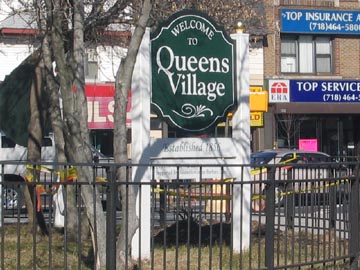
Walking Queens Village


I close the door behind me, take a deep breath, and take two steps down into a peaceful courtyard. Looking to the right I see the vacant park benches where the old folks sit when it’s warm enough. There’s nobody outside on this dank, April morning except one courageous squirrel and a couple of hungry robins looking for their breakfast. . I say “hello” to my neighbor, a grandfather from Sri Lanka whose 5-syllable name I can never remember. Turning to my left I see 88th Ave, a curved road lined with maple trees and cars of every color including my black Buick. The trees are now suddenly filled with green leaves. When did that happen… last night? I walk past my car, cursing the damn bird that dropped a giant turd on my windshield. Taking a shortcut through the 2-story buildings that make up my co-op development, I chuckle at the sight of a “No Trespassing” sign. Ha, I’m finally not a trespasser. I hope somebody stops me to ask why I’m on private property. My destination is my mom’s house on 219th Street, the house I grew up in.

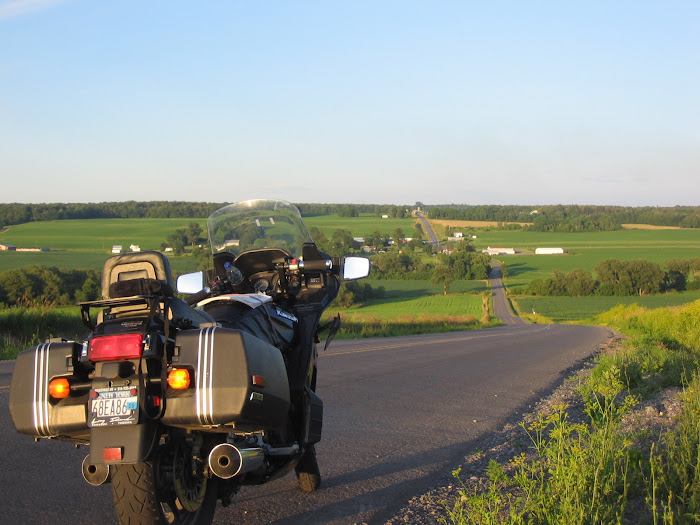
Queens Village has been my home for 37 of the 44 years that I’ve been alive. The streets and houses within its square blocks serve as a photo album filled with snapshots of my life. Another shortcut takes me past a row of green garage doors. I spot John Gunther’s old apartment. I notice the window of the tiny bedroom where I stayed for two weeks when I got kicked out of my house. This shortcut lands me right in front of my brother’s house. I had lived there for fourteen years until I bought my new place in February. I wonder how my nieces are, if there’s any mail for me, and why I haven’t yet started up the motorcycle that I’m keeping in his garage. Mom’s house is only four blocks away. I’ve decided to take the “scenic route” so I can see the old neighborhood. A middle-aged man is walking back from the store with his Sunday paper. An old, sickly-looking man is walking an old, sickly-looking dog. Technically, this is New York City. You wouldn’t know it from this morning’s tranquility. Even Springfield Blvd., a main road, is unusually quiet today. Passing by the chain of Mom & Pop stores brings back many memories. It also accentuates the subtle, yet obvious changes that the neighborhood has undergone. Neil’s Drug Store, Charlie’s Deli, Malley’s Candy Store, Downey’s Bar and Sam’s Cleaners are now a bodega, Nail Salon, Real Estate office, Laundromat and another bodega. What’s wrong with this picture? What happened to this place? Am I the only one left?

While feeling that the neighborhood has lost its charm and character, I continue down Springfield. People aren’t looking me in the eyes when I pass them. Moreover, they seem surprised when I offer a greeting. Throughout my walk I’ve been noticing new houses, all bland, square, brick structures with no personality or character. Our Lady of Lourdes (my old school) doesn’t appear to have changed at first glance. Something’s missing… The schoolyard’s empty… Where are all the kids? Why isn’t anybody playing stickball, football, hopscotch, or just riding bikes? I think of all the fun I had in this schoolyard. I remember the games, the fights and the random mischief. The big church has not changed on the outside either. A few people in jeans enter it, followed by three gray-haired ladies in dresses. The Q-27 drops off some more churchgoers, and then lumbers by as I make my way down to Jamaica Ave.

When I was a kid, going down to Jamaica Ave was called “going to the Village”. There was a certain “flavor” to the Village that I can no longer detect. The once magnificent Queens Theatre, for example, has been abandoned for years. In the early 70’s, the town united to protest the changing of the theatre’s films to porn. They not only stopped showing porn, they stopped showing everything. It remains boarded up to this day. Woolworth, Kitty’s Pizza, and Winter’s Ice Cream Parlor have been replaced by a 99-cent store, a Car Service, and one of those storefront churches. The city actually did a nice job restoring “the Plaza”. What was once a seedy hangout for druggies is now a tidy, memorial park dedicated to local war veterans. The once familiar flavor of the neighborhood might be gone, but it appears to have been replaced with an assortment of new and exciting flavors.

Queens Village has become enormously multi-ethnic. On this particular day, I pass by Haitians, Jamaicans, Filipinos, Puerto Ricans, Indians, Portuguese, Chinese, Koreans, Mexicans, just to mention a few. I like the diversity. Still, I sense something is a tad askew. On my walk, I couldn’t help but notice how everyone seems to be on his or her own little mission. Nobody seems to have time to deviate from what they’re intent on doing. Despite being crowded, I see little interaction between neighbors. As I watch the Village come alive on this day, I daydream of organizing a big Multi-Ethnic Festival on Jamaica Ave. It’s time to put QV back on the map! Let’s get everyone together and bring back The Village! I turn right on 218th Street. Here are more brick boxes. Disgraceful! Can they make these houses any more hideous? A few homeowners are out doing yard work. There are a couple kids riding their bikes on the sidewalk. Ha! We never had to wear those stupid looking helmets. The snapshots of my childhood continue to present themselves. I pass the old homes of old friends, teenage hangouts and our old football field next to the library. I pick up the plethora of advertisements from mom’s stoop, walk up the driveway, take out my keys, and go inside the house of my childhood

Tuesday, April 27, 2010

What to Pack?!


Something in my personality prevents me from getting excited about future events.
In 3 days I'll most likely be on a beautiful, tropic beach.
I know I should be stoked, but I've actually given the trip very little thought.
I have not packed, have not made a list of supplies or other things to bring.
In my mind, until the plane touches down in Nassau, I am not excited.
What the fuck is wrong with me. Part of the fun of a vacation is the anticipation, the planning, the daydreaming. I deny myself of pleasure by being skeptical that everything will go right. I feel that there are too many things that can prevent a trip from being successful. What nonsense!!! That's it! From this moment on, I am EXCITED!!! I'm going to the BAHAMAS!!! I'll be swimming in turquoise colored water! I will be walking hand in hand on an exquisite beach with my beautiful girlfriend. I'll be watching the sun come up. We'll be watching the sun go down. I can't wait!!!

Thursday, April 22, 2010

"Shroud" vs "Burka"


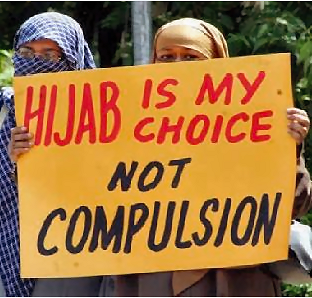
In comparing the two essays: Shrouded in Contradiction by Gelareh Asayesh and An Identity Reduced to a Burka by Marayati & Issa, I found a big difference in approach and attitude. "Shrouded" is one woman's struggle with the mixed emotions of wearing traditional Islamic garb. Asayesh longs for the days when women in Tehran could choose what they would wear. She is somewhat rebellious because she does not like being told she must, when the men can wear what they please.
In "Burka", the authors are taking a defensive stand against western perception and stereotyping of Islamic women, especially when it comes to wearing "the veil". "The press tends to view Muslims...simplistically", is their claim. They resent the Western world's "obsession" with the "the veil" and the misconception that the only reason Muslim women wear their religious clothes is out of obedience to the powers that be. Throughout the Islamic world, however, the opposite is true. Some Islamic nations such as Turkey view it as rebellious. According to Marayati & Issa, more importance should be placed not on what a woman wears, but "by the dedication, knowledge, and skills she brings to the task at hand".
Both essays are educational for a person unfamiliar to the stories behind the Burka and hijab (Islamic covering). "Shrouded" is simply one woman's peeve, and an and the other is more of a rant filled with a brief historical lesson and hostile defense against stereotyping Muslim women.

Cause of Death


When the medical examiner asked me if I wanted an autopsy done on my dad, I declined.
I already knew what killed him. Stress was the cause of death!
The man was carrying the world on his shoulders. His oldest son was mentally ill and a gigantic pain in the ass.
His wife became mentally ill at a time when he needed her the most.
He was the only one of his 4 brothers taking care of his elderly mother.
I am so afraid of all that happening to me. maybe that's why I am not married and have no children. I hate stress and am deathly afraid of it.

Tuesday, April 20, 2010

Mute- In an English Only World

Chang-Rae Lee wrote about the problems facing a Korean Immigrant family in New Rochelle. His mother, despite great efforts to learn how to communicate in English is traumatized when she accidentally orders ox-tails in her native tongue. It made me realize how insensitive I and other "Americans" can be to the plight of foreigners. Lee understands why that may be, but reflects on his mother's frustration and fear about speaking in English. Essays like this and those by Naylor, Tan, et al are helping me to be more aware of the feelings exprienced by those struggling to fit in to a society that I've always been comfortable with.

Catering our Words to a Particular Audience


As I walked to the store with my friend's 13 yr. old son, I said very little, but listened very much. When I did speak, it was with the thought of teaching, correcting and encouraging. Would I communicate the same way with my brother, mother, co-worker, or professor? Of course not! Throughout our days, we speak to various people. Young, old, male, female, rich, poor, etc...Should we speak the same way to everyone? I believe NOT. With each audience comes a different objective. Am I trying to: Teach? Empathize? Persuade? Impress? Amuse? Entertain? Acquiesce? Since words have power to influence, they should be carefully crafted in respect to their target. It would be foolish to speak to everybody in the same fashion.

My Last Meal


It was delivered promptly, wrapped it aluminum foil and still hot. $4.95, not a bad deal, I guess. I let it sit a while, then put it on a plate. I took it with both hands and tore one end apart from the other, as cheese was acting like some sort of delicious epoxy. I took a bite, tasting the dough and a slight accent of garlic. I pulled my mouth away, taking some of the main ingredient with it. I reminded myself (as I always do when I eat this particular item) to check my teeth for the green residue that always seems to get lodged between them. Too bad Popeye the Sailor didn't live long enough to experience this delicacy. He just ate it straight from the can. But Italian Affair mixes it with cheese and garlic and bakes it in Pizza dough.

Thursday, April 15, 2010

War: What is it Good For?


If the world, or big parts of it, did not thwart the Nazi threat, where would it be today?
War, because of the world we live in and the place in time we are, is a necessary evil.
Most wars are avoidable and unnecessary, the result of greed, imperialism, or just plain insanity.
Nations, therefore, need to defend themselves, and governments need to protect it's citizens.
Personally, I wish there were no wars at all.
I happened to be born at the perfect time. I turned 18 in 1978. Vietnam had just ended and there was no imminent threat. No need to draft. No need to enlist.
You certainly wouldn't find me enlisting in order to fight for something I don't believe in, nor understand.

Tuesday, April 13, 2010

What's in a Name- Gloria Naylor


Naylor came to understand the word "nigger" in different ways. When young the word was spoken among blacks casually and could be positive or negative. Although the word was spoken in front of her dozens of times, she claims to have never "heard" it until it was used as a slur against her in 3rd grade. Naylor writes: "Words themselves are innocuous; it is the consensus that gives them true power". By itself, a word such as nigger should have no lasting impact. If a group unitedly agrees (consensus) that it is derogatory, then , when slung in a harmful way the word gains "power".
Interestingly, Naylor is not an advocate for ousting the word from our syntax. She reasons that it would still be on the "white mind" regardless. She also believes that use of the word among blacks, when used within the "rules" of language, renders the negative aspect of it "impotent". In Naylor's view, her black peers have "transformed" the word "nigger" to where it represents the complexity and varied nature of black people. Coming through loud and clear, however, is the negative impact it could have on someone not understanding the true nature of the expression (as she sees it).

Words that Hurt


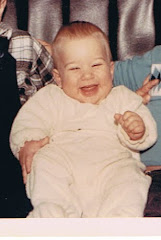
Looking back at photos of my youth, I looked like a thin kid. For some reason, I developed a little hang up about being fat. A kid named David McDonald once made a comment about me being pudgy and I felt like crying.. Later, this kid, Anthony, a major ball-breaker who had a derogatory nickname for everyone, would call me Blobert, or Blob, or Blobby. I hated that! Now, I look back and laugh because, let's face it, it's funny as hell. At the time I would cringe. To this day, I am very aware of my weight and the size of my belly. I'll say I'm fat, others think I'm nuts.

Naylor's What's in a Name vs. Cullen's Incident


These two pieces center around the term "nigger", (which for the time being I am allowed to say). Both writers have specific occurrences where the word is used as a hurtful slur. Both were rather young at the time and both were affected in a profound way. it's hard to compare the two works, since Cullen's is a very brief, poetic account containing no background or reflection. Naylor reasons that the term has been transformed by her black peers to represent the uniqueness and complexity of the black people she knows. Naylor also seems less bothered, experiencing more confusion than anything. Both works, do show the poignant emotional effects that words, when meant to scar, can have.

Thursday, April 8, 2010

Who Can I Relate To?


So far in my English class, we've heard from, Black men, Jewish women, Native American men, West Indian women, Indian woman Latin Women, African woman oh I forgot...Shelby was a white man, and so was Paul Theroux but I can't relate to any one of these authors. At the same time I can relate to all of them. They are all human beings with mother's, lovers, vises, and opinions. I am benefiting from the assortment of writers. It helps us to get along as neighbors. I didn't like Theroux, he sounded pretentious and bitter. I want to be able to understand everybody.

Tuesday, April 6, 2010

STEREOTYPES


i'M WHITE, AN YES, i CAN'T DANCE.
If I've been stereotyped, it happened behind my back.
Of course there is some truth to many stereotypes.
As time goes on, and generations come and go...so do the stereotypes.
Generalizing is closely related to stereotyping.
It is dangerous, IGNORANT even, to generalize.
Jews are cheap! Blacks are lazy! White people have no rhythm. Asians can't drive! Women belong in the kitchen! Irish people are Drunks! Polish people are stupid! Italians are into Organized crime! Germans are Nazis! Men are insensitive!
Within every group, culture, race, genre, whatever... there are those who have these qualities and those who don't.
It's a slippery slope to stereotype, especially in this age of "Political Correctness"